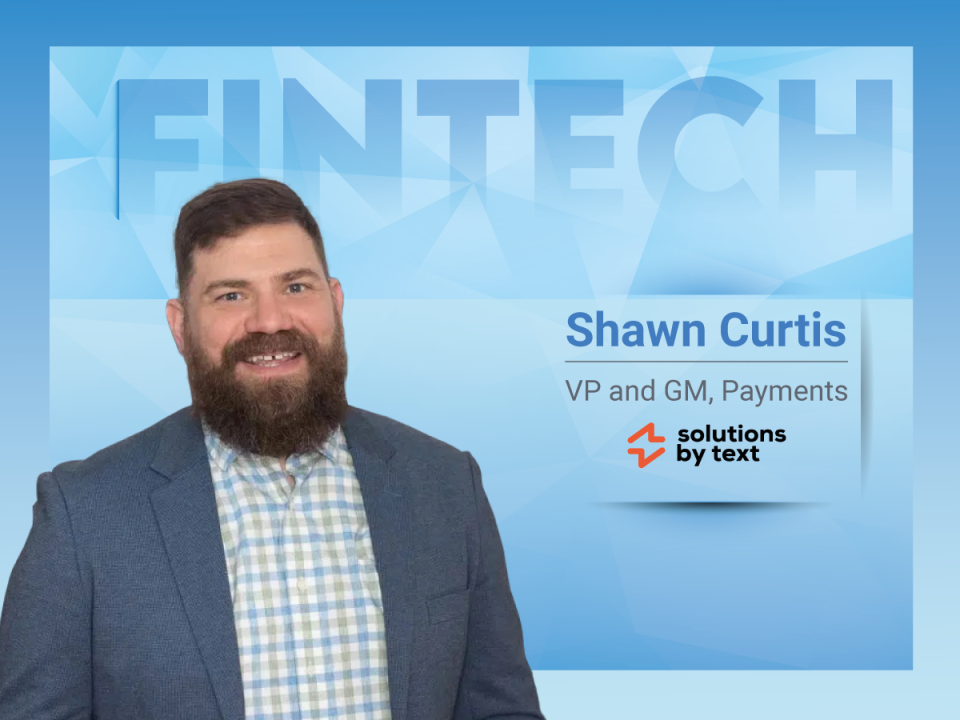
Shawn Curtis, VP & GM, Payments at Solutions by Text chats about the current digital payments landscape in this Global Fintech interview:
___________
Hi Shawn, tell us a little about yourself.
I’ve spent my career in payments and financial technology, working at the intersection of complex infrastructure, real money movement, and regulated environments. It’s a space where execution shows up quickly. If the experience is simple, people complete transactions. If it’s not, they don’t.
I’ve worked across multiple layers of the payments ecosystem, and that’s shaped how I think about the role payments should play. It’s not just infrastructure. It’s a core part of the customer experience and a meaningful driver of business outcomes.
Today, I’m the GM of Payments at SBT, where I lead the strategy and operations of our FinText Payment Services platform. My focus is on building a payments business that scales efficiently while maintaining a strong compliance foundation.
At SBT, we help businesses engage customers through messaging in a way that is simple, direct, and secure. More importantly, we turn those interactions into outcomes like completing a payment or resolving an account.
Most payment experiences still create friction. Too many steps, too many logins, too many chances for drop-off. We remove that friction by bringing payments directly into the messaging experience, meeting consumers where they already are.
The result is straightforward. Faster payments, higher completion rates, and better economics for our customers, including outcomes like up to 400% ROI and significantly faster time to revenue.
How will your recent acquisition of TPP change the game for end users?
Acquiring Triple Play Pay was a big step forward in how we bring payments directly into the messaging experience. By adding TPP’s payment orchestration capabilities into our FinText platform, we’ve created a more unified and streamlined foundation for our customers. We’ve simplified how businesses onboard, manage, and scale payments—reducing friction, eliminating the need for multiple vendors, and enabling them to move faster from conversation to completed transaction.
The business impact is immediate—faster time‑to‑value—but for end users, it means a smoother, more secure way to complete transactions inside the channels they use every day. We’ve also strengthened fraud protection and transaction monitoring so that convenience never comes at the expense of safety.
This acquisition keeps advancing our payments experience, especially with RCS‑enabled threads that bring verified identity, branded messaging, and one‑tap payment buttons together. We’re making every message not just more recognizable and reliable, but easier to act on to close the gap between communication and conversion.
Read More on Fintech : Global Fintech Interview with Baran Ozkan, co-founder & CEO of Flagright
What are some of the friction points or weaknesses you’ve often seen in digital payment systems today?
One of the biggest weaknesses I see is that many digital payment journeys are still fragmented. Consumers get an email, then have to jump into a website, download an app, or call into an automated phone system, and maybe get a basic text on top of that—it’s a lot of channel switching. Every channel switch is a chance for the end user to jump ship instead of completing a transaction or application.
As an industry, I think we also still rely too much on apps, even though a significant share of consumers would rather just use text. Many already say they prefer text over apps for financial tasks, and a meaningful share—almost 30%— say they wouldn’t need apps if richer messaging could handle their needs.
And whatever the system, too many of them “inform” rather than enable, meaning the customer gets a notice but can’t pay, confirm, update details, or set up autopay directly from the communication. Add in weak identity cues—no clearly trusted sender, inconsistent branding, suspicious‑looking links—and people naturally question whether a payment request is legitimate.
In collections and repayment, many firms still depend too much on phone calls and paper when we know that conversational text and richer messaging can increase people’s willingness to set up plans and autopay if those interactions are straightforward and they trust them.
What would you share with businesses looking to optimize their payment processes and cycles?
In addition to the obvious—meet your customers where they already are, on their phones—make sure the platform you’re relying on to reach them isn’t fragmented or incomplete. Ideally, a unified approach should be tailored to support the customer journey from intent to action through a payment and messaging platform. From a customer perspective, when a reminder arrives, they want to be able to take the next step right there without being pushed somewhere else.
Also, don’t forget trust. A secure platform that enables consistent branding and secure in‑thread actions reduces fraud anxiety and makes it far more likely that customers will complete a payment when they’re prompted. The best way to do this is on a compliance‑first platform built for financial services, so journeys stay aligned with regulations while still feeling simple and intuitive to the end user.
Finally, measure what matters: on‑time payments, autopay adoption, fewer delinquencies, and lower call‑center volumes—not just opens or click‑throughs—so you know your payments strategy is improving the health of the business, not just generating activity.
What trends will dominate the fintech and payment ecosystems in 2026 in your view?
I think 2026 is the year messaging really becomes the primary way—the front door, if you will—that financial institutions interact with their customers. Consumers are telling us they prefer this. They prefer a seamless experience where they can do everything in one place instead of hopping between apps and portals. As messaging becomes more capable, those threads will start to feel like “mini banking apps” in their own right. You’ll also see the bar rise on what makes a “good” message: it won’t be enough to send an alert. Every message will need a clear next step that lets people actually do something—pay, confirm, update, or apply—right there in the thread.
A few trends really stand out:
- Messaging apps start to edge out mobile banking apps. As rich messaging and RCS mature, more consumers will prefer to handle financial tasks in a secure thread instead of downloading and maintaining multiple apps, especially when those threads offer embedded actions and app-like experiences.
- RCS moves from pilot to standard. Verified senders, rich visuals, and built‑in buttons will become the default expectation, not an experiment, and branded threads become a trusted space for everything from alerts to payments inside one conversation.
- Trust signals become the new currency. Inboxes are noisy and fraud is top‑of‑mind, so visible cues—verified identities, consistent branding, secure links—will heavily influence whether someone even considers acting on a message.
- Compliance becomes a differentiator. As more of the relationship moves into mobile messaging, firms that can move fast while staying clearly within regulatory guardrails will win both regulators’ confidence and consumers’ trust.
What are 5 fintech and pay tech thoughts you’d leave us with before we wrap up?
We’ve talked about a few consistent themes: messaging becoming the front door to financial relationships, rich threads replacing clunky, multi‑step journeys, and the idea that trust and compliance are now product features, not back‑office concerns. We’ve also touched on how RCS with verified identity and in‑thread actions are redefining what “easy” and “secure” feel like for everyday financial tasks.
But rather than give you another list, when you distill it all down, here’s what really matters:
- Enable your customers to act within a conversation, not just listen to you talk at them.
- View your messaging interactions as the most valuable digital asset your brand can own, and treat it that way: design interactions with care, brand them, make them smart, and use them as a tool for an ongoing, active relationship.
- Finally, keep it simple, keep it safe. By innovating within a compliant environment, customers already “get” and use profusely, you’ll make their lives easier and your ties to them stronger than ever.
Catch more Fintech Insights : Real-Time Payments and the Redefinition Of Global Liquidity
[To share your insights with us, please write to psen@itechseries.com ]

Solutions by Text (SBT) enables businesses in the consumer finance sector to effectively and conveniently reach their customers. Through a compliance-first messaging platform that seamlessly integrates payments, SBT helps foster meaningful conversations that drive measurable results. For too long, companies have relied on low-y‑ield communication methods such as phone calls, mail, emails, and apps—leaving customers overwhelmed and messages lost in the noise. SBT’s FinText platform empowers organizations to engage, interact, and transact with consumers through trusted text conversations, backed by deep industry expertise and a focus on compliance and performance.